
The stockroom gets a call. A customer needs six replacement pumps in Bendigo by Friday. A sales assistant finds the correct part and reads “eight in stock” back to the caller. The warehouse has eight pumps, but three belong to orders already waiting for collection. The failure happened before the first token of the answer appeared. The system gave the model a number whose business meaning differed from the question.
On 25 November 2024, Anthropic introduced the Model Context Protocol (MCP), publishing a specification, software development kits and examples of servers connecting AI applications to existing systems. An enterprise could write one stock connector and reuse it across compatible applications. The expensive design decision remained with the warehouse. Which question could it answer reliably, on whose behalf, and what could the caller promise on the strength of the result? Anthropic’s original announcement.
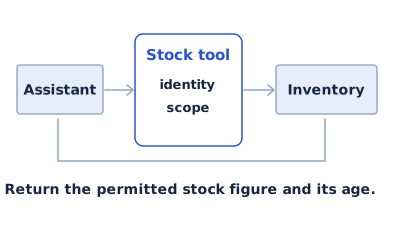
Give the model the warehouse’s definition of availability
In the original MCP tools specification a server describes what a tool does and the inputs it accepts. A client can discover that description and invoke the tool with arguments. For the pump query those arguments might be the part number, depot and unit of measure. The tool description should tell the model that it can look up stock available to allocate. The distinction between a stock lookup and an order reservation matters even if both eventually use the same inventory database. November 2024 MCP tools specification.
Suppose the ledger records eight individual pumps on hand, three allocated and four inbound. The warehouse owner defines available units as on-hand units less existing allocations. The connector can therefore return five available now, the time of the snapshot and the four inbound as a separate field. A person or model can cite those values. A delivery promise needs two additional facts, the receipt time for inbound stock and the carrier’s cut-off for Friday delivery. Neither follows from a count.
Ask the application owner to write down the answer a salesperson could safely give using those fields alone. Here it might be “Five are available now. Four more are due, but I need a confirmed arrival and dispatch date before committing to Friday.” If a model must repeatedly derive that distinction from unrelated notes in a stock export, move the calculation into the connector where the inventory owner can test it once.
Trace the identity through one call
An employee who manages two depots and a distributor who buys from one may ask identical questions. The service that reads stock needs a trusted way to tell them apart. The application can attach an authenticated identity and the connector can resolve the depots that identity may query. A warehouse code generated by the model is an input to validate. Allowing that code to establish the caller’s rights would give anyone who guesses a depot name a second route to its records.
In a demonstration, ask both users to find the same part at the restricted depot. Inspect the returned tool result as well as the final prose. An answer saying “I can’t display this” offers little protection if restricted stock, contract prices or customer names have already entered the model context. Keep denial responses brief enough that repeated queries cannot reveal which confidential records exist. The original protocol assigns input validation and access controls to tool implementations. MCP tool security considerations.
Scroll to see all columns.
| Caller and input | Result available to the assistant | Acceptable response |
|---|---|---|
| Authorised buyer requests six units | Five available at 10:05, four inbound without a confirmed arrival | Quote five available and ask whether a partial shipment would help. |
| Distributor queries a restricted depot | Access denied before any inventory fields are returned | Offer an authorised sales contact without disclosing depot holdings. |
| Employee requests six “packs” | Part exists in individual and carton units | Ask which unit the order uses before calculating availability. |
Price the second model call
A tool lookup usually creates another model turn. The model sees the customer’s question and tool definition, proposes arguments, then receives the result and writes an answer. The second turn can bring the conversation history, tool definitions and returned records back into billed input. A token buyer can estimate the cost by collecting provider usage for both turns and grouping the calls under the same business enquiry. Include tool calls that time out and enquiries that eventually go to a person.
Consider an illustrative 10,000 enquiries in a month, with 8,000 reaching a stock lookup. Suppose a broad inventory response adds 1,700 input tokens to the answer turn and the scoped response adds 200. On one answer turn per lookup, the difference is 8,000 × 1,500, or 12 million input tokens a month. Multiply that volume by the applicable rate per million to estimate the difference in spend. If only half the enquiries reach a lookup, the same design saves 7.5 million input tokens. Output charges, cache treatment, extra calls and connector operating costs belong on separate lines.
That reduction is worth pursuing only if the narrower result still answers the question. Removing units or the snapshot time can save tokens and increase follow-up calls. Replay the same enquiries through each version. Compare the proportion answered correctly on the first contact, total tokens across the entire enquiry and the longest waits during a busy period. If the warehouse service spends most of that time waiting on its ledger, buying more inference capacity will do little for the customer on the phone.
Accept the connector on a Friday afternoon
Build the acceptance set with the people who handle late orders. Include a recently reserved unit, a change in carton size, a restricted depot, an empty result and a timeout immediately before dispatch. For each case, specify what the warehouse system can establish and what the assistant must ask. Repeat a query while another buyer reserves the last unit. An answer should make its observation time visible and offer a fresh check before anyone commits stock.
A pilot can use Cooma Model API to give the application a project key with approved model access, usage limits and spend visibility. Confirm tool-calling support for the selected model and API. The inventory owner supplies the connector, authorisation and stock rules. Keeping those responsibilities explicit lets procurement change the model without having to renegotiate what “available” means. The reason to widen access later is a documented class of unanswered enquiries that the next field or tool would actually resolve.