
A manufacturer wants its maintenance assistant to run in Australia. One bidder offers an Australian GPU server. Another offers a model API with an Australian billing entity. Before comparing prices, the manufacturer needs the answer to a more revealing question: when an engineer pastes a confidential fault report into the assistant at 2 am, who can read it, where is it processed, and what happens if that service is down?
Australia’s National AI Plan, released on 2 December 2025, put investment in infrastructure and domestic capability alongside adoption, skills and safety. Those aims give buyers a reason to ask what capability they are buying locally. The plan does not answer the operational questions about a particular model, provider or deployment. For the manufacturer, those answers belong in the design and the acceptance test.
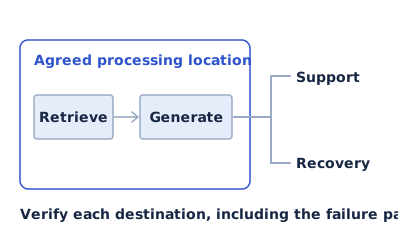
Follow the fault report, including the bad answer
The engineer’s request contains a serial number, a fault code and a note about what happened on the line. The application retrieves a passage from an equipment manual and sends it to a model with the note. The model returns troubleshooting suggestions. The engineer marks one as wrong. So far the design team has drawn three boxes: application, document store and model. The feedback button reveals the missing fourth: someone will open a support ticket to investigate the failure.
If that ticket includes the original prompt, it can carry the same sensitive information as the model request. A database backup can retain a deleted note. A monitoring service can capture an error payload even when routine request logging is switched off. These are different copies, created by different teams for good reasons. Moving the model closer to the factory will not move those copies with it.
Scroll to see all columns.
| Step | Question to resolve | Evidence to inspect |
|---|---|---|
| Retrieve | Can a contractor retrieve an internal incident note alongside a public manual? | A test with two identities and the same query. |
| Infer | Which model endpoint receives the passages, including on a retry? | The configured route, approved alternatives and a request trace without the sensitive text. |
| Investigate | What does an on-call operator see after a bad answer? | A sample ticket, access record and the workflow for temporary support access. |
| Recover | Where can a backup be restored, and by whom? | A restore exercise with the destination, credentials and expiry recorded. |
Specify what must stay local
The purchasing team can now replace “Australian AI” with instructions a supplier can price. For example: incident notes may be processed only in agreed Australian locations; request logs must omit their contents; an unavailable model must return a controlled failure rather than retry through an unapproved endpoint. A public product manual might allow more options. Classifying the inputs separately avoids paying the cost of the strictest design for every request.
The Australian Signals Directorate’s cloud risk assessment guidance is useful background here: it starts with the sensitivity of the information and the specific service being assessed. For this buyer, the practical output is a short list of named responsibilities. Who approves a new model route? Who can turn on diagnostic logging? Who tells the maintenance team when a change affects an agreed location? “Hosted locally” assigns none of those jobs.
Price the recovery behaviour, not just the normal hour
Suppose the team measures a peak of 90 accepted requests per minute. In an illustrative load test, one replica sustains 60 per minute at the required response time and answer quality. Two replicas cover normal demand. Losing one leaves 60 per minute, a shortfall of 30. If peak arrivals continue for ten minutes, 300 requests accumulate. When both replicas return, their combined spare capacity is 30 per minute; it takes another ten minutes to drain that queue. This assumes no retries, no abandoned jobs and a constant arrival rate. A working service and an acceptable wait are two different outcomes.
A third identical replica could cover the loss of one, provided the replicas do not share the failed component. Three allocations on one host are no answer to a host failure. Another option is to let routine manual lookups wait while line-stoppage enquiries take priority. A second model endpoint is a third possibility, but only if it meets the location, data-handling and quality requirements. Ask each bidder to cost the same failure case. Otherwise one quote may buy idle reserve that another quietly replaces with an overseas route.
Choose who operates the model
A dedicated deployment gives the customer choices about the model, serving software and load profile. It also creates a job for someone: patch the runtime, check new weights, monitor queues and recover the service. With Cooma TokenFactory, the useful starting brief is the exact workload, required location, failure scenario and the split of operating responsibilities. Dedicated hardware on its own says nothing about where the application sends its logs.
With a model API, the primary buying unit is a request to a selected service. Cooma Model API offers model access with project keys and usage controls. A key can define who may use a model or how much a pilot can spend; it does not establish where that model processes a prompt. Confirm the selected model’s processing and retention terms, and whether an alternative route is permitted. It can be perfectly sensible to use a model API for public manuals and a separately approved deployment for incident reports.
Run one acceptance exercise before signing off
Give the pilot a synthetic fault report with an unmistakable serial number. Submit it, trigger a bad response, open a support ticket and simulate loss of the primary route. Ask the operator to show the authorised route, the record of the failed attempt and the ticket that support received. Verify where the serial number appears and whether the service queued, declined or rerouted the request as agreed. Test restoration separately; a dashboard saying a backup exists is not a restored service.
The most useful line in the purchase order may be the simplest: what the engineer should see during those ten minutes, and who can explain why. It ties geography, GPU capacity and model access to an outcome that both the plant manager and the supplier can verify.