
A supplier portal times out immediately after an agent submits a purchase order. The approval was valid. The order number never came back. An agent that retries might buy the goods twice. One that simply announces failure could send the buyer to place the same order manually. The useful next action is to look up the submission or hand it to someone who can. This is a harder oversight problem than deciding whether the agent may read a price list.
On 18 February 2026, Anthropic published observations from Claude Code and its public API. More experienced Claude Code users enabled full auto-approval in a greater share of sessions. They also interrupted Claude in a greater share of turns. Those measures have different denominators. Neither establishes that removing an approval made a task safer. They suggest two distinct questions for a pilot owner. Which actions may proceed unattended, and can a person still intervene in time when actual conditions change? Anthropic’s study of agent autonomy.
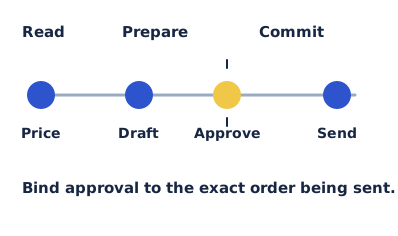
Put the approval where the commitment happens
Consider a buyer sourcing 24 replacement filters. Reading an approved catalogue, matching a part number and calculating a draft total are preparation. The first material commitment is transmitting an order to the supplier. At that boundary a supervisor needs the supplier identity, item, quantity, pack size, price, delivery terms and destination together. Six earlier prompts asking whether the agent may continue do little to help the supervisor catch a carton conversion error on the final order.
Separate ambiguity from authorisation. A requisition for 24 items and a price of A$180 per carton of 12 imply two cartons at A$360, before freight and tax. Entering 24 in a portal that expects cartons creates an A$4,320 line. Both figures are arithmetically correct under their respective units. If the catalogue omits the pack size, the agent should ask for that fact before drafting the order. A manager approving an ambiguous calculation adds little assurance.
Record the exact draft shown to the approver. If the supplier switches warehouses, increases the price or changes from individual units to cartons while the draft is open, obtain a fresh decision on the changed terms. A small application can implement the rule by assigning the draft a version and permitting submission only for the approved version. Put the check in the service that places the order so that a model change cannot silently change the rule.
Give the operator a recovery path
The operator’s screen should distinguish an order waiting for approval from an order whose submission outcome is unknown. In the first state the buyer can edit or cancel the draft. In the second, the supplier may already have acted. If the portal supports a stable client order reference or an idempotency key, use its documented semantics and reconciliation endpoint. Where the supplier offers neither, queue the ambiguity for a person before another submission. Amazon’s engineering account of designing safe retries.
Scroll to see all columns.
| Signal | Permitted next action | Evidence to retain |
|---|---|---|
| Quote lists a carton price but omits pack size | Retrieve the catalogue entry or ask the buyer. | Which unit was missing and where the confirmed value came from. |
| Complete draft matches the approved terms | Submit that version once. | Approver, timestamp, draft version and client reference. |
| Supplier times out after submission | Query by reference or send the case for reconciliation. | Attempt time, request reference and last known supplier state. |
| Supervisor presses stop after supplier acceptance | Block further agent actions and open the supplier’s cancellation process. | Supplier order number, operator decision and cancellation outcome. |
A visible stop button is useful only if the people operating it know its effect. During a drill, stop the agent while it is composing, again while a tool request is in flight, and again after the supplier has accepted the order. Observe which pending actions the application can cancel and which external changes need a separate remedy. Anthropic’s guidance on effective agents recommends checkpoints for human feedback and explicit stopping conditions, including a maximum number of iterations. The supplier’s own behaviour determines what recovery is possible after a checkpoint. Building effective agents.
Measure the labour that remains
A pilot should record ordinary completions as carefully as exceptions. Suppose 100 draft orders each trigger four preparation approvals and a final sign-off. At an assumed 15 seconds per preparation prompt, those 400 clicks alone consume 100 minutes. Replacing them with exception review on 20 orders at two minutes each would consume 40 minutes, a nominal saving of one hour. Final sign-off is common to both approaches and excluded from that comparison.
The saving disappears if exceptions average five minutes, or if people spend the released hour continuously watching the agent. Include observation time, time spent restoring failed orders and the cost of any duplicate commitments. For the model budget, record total input and output usage across each completed order, including abandoned calls and retries. A model that cheaply drafts a line item but repeatedly asks a buyer to look up the same pack size can still be the more expensive option.
Sample completed orders for silent mistakes. Deliberately seed a changed price, a missing unit and a timeout after acceptance in the test environment. Count the cases in which the agent asked the right question, the cases a supervisor caught, and the errors that reached the supplier simulator. A lower interruption rate is good only if the remaining outcomes justify it. The procurement team can also compare the value of the incorrect orders each design would have submitted. A single carton error may outweigh the time saved across dozens of ordinary orders.
Agree who can release the next order
For a first pilot, let the agent prepare a draft and require an authorised buyer to release it. Agree in advance what would justify broadening that permission, who reviews unresolved submissions and how quickly a supervisor must be available. If orders arrive after hours, test what the system tells the requester while a decision waits. A technically sound approval step still fails the business when the goods miss the last dispatch window.
Model access and purchasing authority have separate owners. An application team can scope a Cooma Model API project key to approved models and place limits on usage while it evaluates the workflow. That budget caps the exposure the model-access arrangement covers. The procurement system must independently enforce spending authority, validate the approved order and reconcile the supplier response. For the buyer deciding whether to expand the pilot, the most informative demonstration is a failed submission that ends with precisely one order and a record explaining how the team knows.